
Getting Back to Your Best Primal Self: A Coach's Guide to Functional Fitness
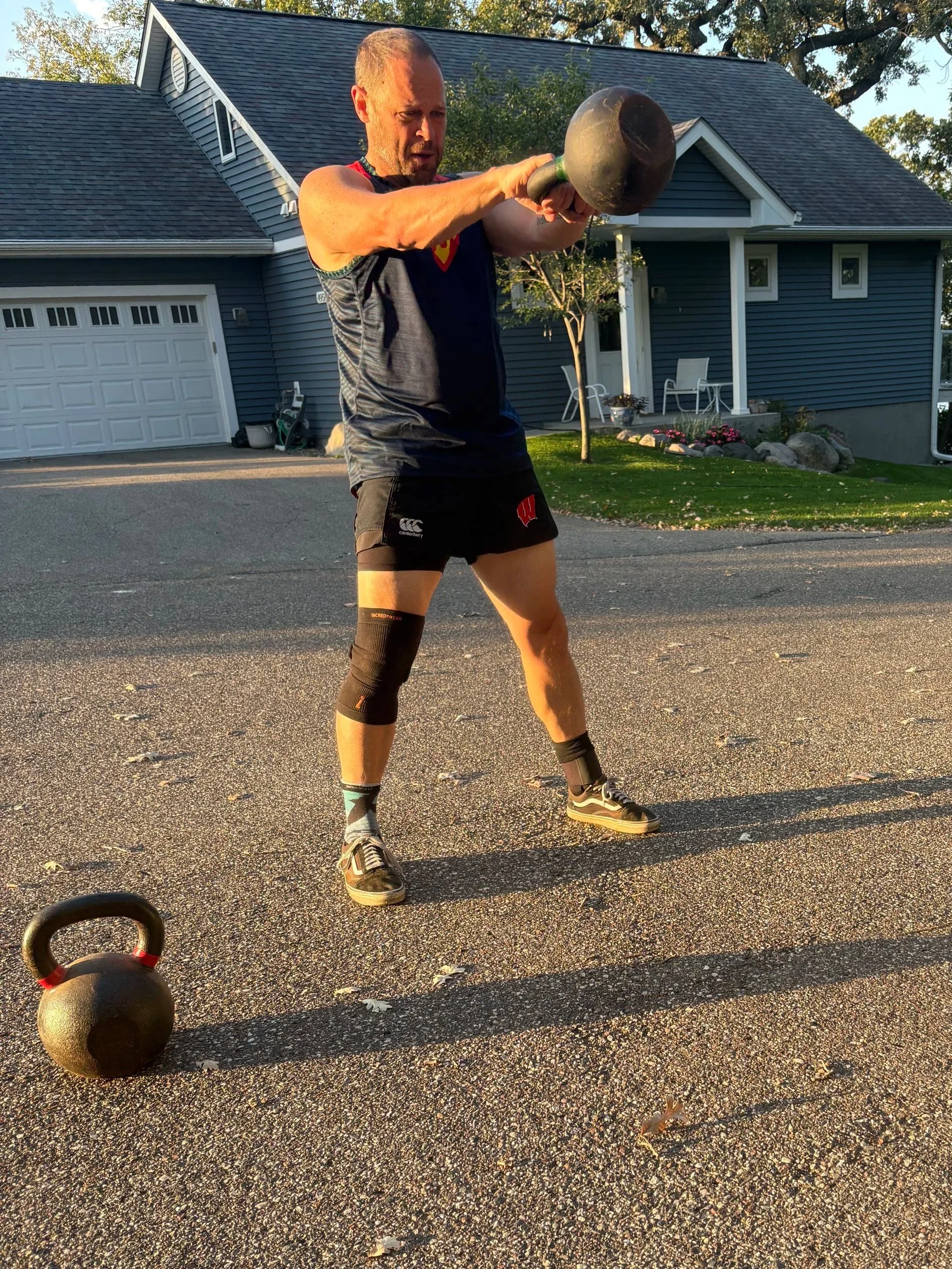
Coach Ryan McDowell performing kettlebell swings outdoors
After many years of working with everyone from weekend warriors to professional athletes, I've learned something crucial: the human body wasn't designed for the modern world we've created. We sit in cars and chairs for hours, stare at screens, and move in the same repetitive patterns day after day. Then we wonder why our backs hurt, our shoulders are tight, and we feel disconnected from our physical capabilities.
The answer isn't another fitness trend or the latest workout gadget. It's about getting back to something fundamental—your primal self.
What Is Primal Fitness?
When I talk about primal fitness, I'm referring to the movement patterns that are hardwired into our DNA. These are the movements our ancestors performed daily to survive: squatting to gather food, lunging to navigate uneven terrain, pushing and pulling to build shelter, carrying loads across distances, and moving quickly when necessary.
Your body is designed for these movement patterns. When you strip away the complexity of modern fitness and return to these fundamental movements, something remarkable happens. Your body remembers. It responds. It transforms.
This isn't about going back to living in caves or abandoning modern life. It's about recognizing that while our environment has changed dramatically over the past few hundred years, our bodies haven't. We still need the same variety of movement, the same physical challenges, and the same connection to our physical capabilities that kept our ancestors healthy and resilient.
The Problem with Conventional Fitness
Walk into most gyms and you'll see rows of machines designed to isolate individual muscles. Leg extensions. Hip abductor squeezes. Chest presses. The underlying philosophy is that if you strengthen each muscle independently, you'll build a strong, functional body.
But here's what I've observed over nearly three decades: this approach creates bodies that look strong but often move poorly. Why? Because life doesn't happen in isolated movements. When you pick up your child, you're not simply performing a biceps arm curl—you're coordinating dozens of muscles across multiple joints while maintaining balance. When you lift a box, twist to place it on a shelf, or sprint to catch a bus, your body works as an integrated system.
Primal fitness recognizes this reality. Instead of isolating muscles, we train movements. Instead of sitting on stable machines, we challenge your body to create its own stability. Instead of following a predetermined range of motion, we develop the mobility and control to move freely in all directions.
The Seven Primal Movement Patterns
Through my work with hundreds of clients and athletes, I've identified seven fundamental movement patterns that form the foundation of functional fitness:
1. Squat/Hinge
These lower body movements involving hip flexion and extension are perhaps the most fundamental human positions. The squat—whether you're sitting down and standing up, or picking something off a low shelf—is something children do naturally with perfect form. The hinge—the foundation of deadlifts and safely lifting objects—is how we're designed to bend forward while protecting our spine.
Together, these patterns build the posterior chain strength and hip mobility that form the foundation of pain-free movement. Most back pain stems from poor hinge mechanics—people rounding their lower backs instead of hinging at the hips. Master these patterns, and you've taken a major step toward a resilient, capable lower body.
One of my favorite ways to build squat strength is through medicine-ball front squats. Holding a load at your chest while squatting through an appropriate range of motion, the isometric hold of the upper body for 20-30 seconds combines with hip movement to create a very functional exercise. This builds tremendous stability and teaches your body to create tension in the most challenging position. You'll also benefit from eccentric squats, where you lower slowly over 3-5 seconds. These controlled negatives build strength throughout the entire range of motion and significantly reduce injury risk.
2. Lunge
The lunge is your single-leg strength and stability pattern. Life rarely happens on two feet with perfect symmetry—you're constantly stepping up stairs, navigating uneven ground, or stabilizing on one leg while reaching for something. Walking lunges, Bulgarian split squats, and single-leg movements expose and correct the imbalances that lead to injury. We need to be strong with our knees behind our hips in true hip extension.
I've watched countless clients discover they're significantly stronger on one side than the other. This asymmetry isn't just a training curiosity—it's an injury waiting to happen. Lunging patterns build the unilateral strength and stability that keeps you balanced and resilient.
For clients who struggle with balance or are rebuilding strength, I often program isometric split squats—holding the bottom position of a lunge for time, advancing to balancing only on the balls of your feet! This builds stability without the coordination challenge of movement and creates a solid foundation for more dynamic work.
3. Step
The fundamental stepping motion is crucial for all locomotion. Whether you're walking up stairs, stepping onto a curb, or hiking up a trail, your ability to efficiently step and transfer weight from one leg to another determines your movement capacity.
Step-ups, box steps, and stair climbing train this pattern, building the single-leg strength and coordination needed for navigating the three-dimensional world we live in. This isn't just about leg strength—it's about the neural coordination that allows smooth, efficient movement.
Eccentric step-downs—slowly lowering yourself from a box or step—are incredibly valuable for knee health and building control. The slow, controlled descent forces your muscles to work hard while lengthening, which builds resilience in tendons and connective tissue.
4. Push
Pushing movements include everything from pushing yourself up off the ground to pressing weight overhead to moving heavy furniture. Push-ups, bench presses, and overhead presses all train your body's ability to generate force away from your center.
In our modern world of pushing keyboards and car steering wheels, we need to maintain the upper body strength and shoulder stability that pushing movements develop. These exercises teach your body to transfer force from the ground through your core and into your arms—a skill that translates to nearly every physical task you'll encounter.
If you can't do a full push-up yet, eccentric push-ups are your secret weapon. Lower yourself slowly to the ground over 3-5 seconds, then reset to the top. You're much stronger in the lowering phase than the pushing phase, so this builds strength quickly. No pushups on your knees! Keep your trunk engaged while not overloading the hip flexors. Elevated pushups or even wall holds—an isometric push position against a wall—will build the shoulder stability needed for safe pressing.
5. Pull
Pulling movements—whether pulling yourself up, rowing weight toward your body, or pulling something down from overhead—are critically important in our push-dominant modern world. Pull-ups, rows, and face pulls build the posterior chain strength that keeps you upright and counteracts the rounded-shoulder posture most people develop from desk work and screen time.
We do far more pushing than pulling in daily life, which creates imbalances. Deliberate pulling work restores balance and builds the back strength that protects your spine and improves your posture. If you do nothing else, balance every push with a pull.
For pull-ups, the eccentric phase is where most people should start. Jump or step to the top position, then lower yourself as slowly as possible—aim for 5-10 seconds. This controlled negative builds the strength needed for a full pull-up faster than any other method. Isometric reclined rows—simply holding onto a bar or rings with a 90-degree elbow while leaning back—are an essential isometric that builds grip strength and shoulder health.
6. Rotation
Rotation is the often-neglected movement pattern that happens in the transverse plane—twisting your torso and pelvis. Life is full of rotational movements: swinging a golf club, reaching for something behind you in the car, playing catch with your kids, or simply turning to look over your shoulder.
Yet most traditional fitness programs ignore rotation entirely, creating bodies that are strong moving forward and backward but vulnerable when twisting. Medicine ball throws, wood chops, and rotational exercises build the cross-body core strength that actually matters for daily life and athletic performance. Training rotation safely and progressively is essential for spinal stability and injury prevention.
Isometric rotational holds—such as Pallof presses where you resist rotation by holding a band or cable at your chest—build incredible core strength. These anti-rotation exercises teach your body to create stability while forces try to twist you, which is exactly what happens in sports and daily activities.
7. Locomotion
This includes everything from loaded carries to walking, rucking, sprinting, and running. Humans are meant to move across distances and varied terrain, carrying what they need with them. When we limit ourselves to flat treadmills and predictable environments, we miss opportunities to challenge our cardiovascular system, build real-world strength, and develop the work capacity that defines functional fitness.
Farmer's carries, suitcase carries, rucking with a weighted pack, and varied running speeds all train your body to move efficiently under load. I've watched clients transform their functional capacity through simple loaded carries. Suddenly, carrying groceries isn't exhausting. Hauling luggage through airports becomes manageable. Moving furniture doesn't leave them sore for days.
Loaded carries are essentially isometric holds in motion—your muscles maintain constant tension while you walk. This builds endurance and stability in a way that traditional exercises can't match. For building foundational strength, try farmer's carry holds where you simply stand holding heavy weights for time before you walk.
Building Your Adventure-Ready Body
I often tell my clients that we're not training to look good in a mirror—we're training to be ready for adventure. Whether that adventure is hiking in the mountains, playing with grandchildren, tackling a home improvement project, or simply navigating daily life with energy and confidence, functional fitness prepares you for what matters.
Here's how to start:
Assess Your Current Movement
Before adding weight or intensity, understand how you currently move. Can you squat to full depth with your heels down? Can you hinge at the hips without rounding your back? Can you lunge with control and stability? Can you get up and down from the floor smoothly?
These assessments reveal where you need mobility work, where you need stability, and where you're ready to add challenge. Over my 18,000-plus hours of coaching, I've learned that starting from an honest assessment prevents injury and accelerates progress.
Prioritize Movement Quality Over Quantity
One perfect squat is worth more than ten sloppy ones. In primal fitness, we emphasize mastering fundamental patterns before adding load, speed, or complexity. This patience pays dividends—bodies that move well handle stress better, recover faster, and stay injury-free longer.
Incorporate Time Under Tension
Your muscles don't just need to move weight—they need to control it through all phases of movement. Concentric movement (when muscle shortens during the activity), eccentric training (slow, controlled lowering) and isometric holds (static positions under load) increase time under tension, which builds strength, stability, and resilience.
Train All Seven Patterns Regularly
A balanced program includes all seven primal movements. You might push and squat in one session, pull and lunge in another, and dedicate time to rotational work and loaded carries throughout the week. Or perform all of them in a total-body circuit. The key is variety—your body needs all these patterns to remain balanced and resilient.
Embrace Unilateral Training
Single-leg work through lunges and step patterns reveals imbalances you didn't know existed. Train one side at a time with lunges, single-leg deadlifts, and one-arm carries. Life rarely happens with perfect symmetry—your training shouldn't either.
Don't Neglect the Transverse Plane
Most people train exclusively in the sagittal plane (forward and backward) and maybe the frontal plane (side to side). The transverse plane—rotation—is where many injuries occur because it's undertrained. Make rotational work a regular part of your program, including both dynamic rotations and isometric anti-rotation exercises.
Progress Thoughtfully
Start with bodyweight movements. Master the pattern. Then add load gradually. A goblet squat before a barbell back squat. A box step before a heavy step-up. Push-ups before bench press. And always remember: eccentric training and isometric holds are powerful tools for building strength safely, especially when you're learning a new movement or working around an injury.
Respect the progression, and your body will reward you with steady, sustainable progress.
The Transformation I've Witnessed
I've watched this approach transform hundreds of lives. I've seen 50-year-olds move better than they did at 30. I've watched former athletes who thought their best physical years were behind them rediscover capabilities they'd forgotten. I've seen people eliminate chronic pain, gain confidence, and reclaim activities they thought they'd lost forever.
The common thread? They stopped chasing arbitrary fitness goals and started training for life. They stopped isolating muscles and started integrating movement. They stopped fighting against their body's natural design and started working with it.
One client recently told me, "For the first time in years, I feel like my body works the way it's supposed to. I'm not worried about throwing my back out or whether I can handle physical challenges. I just move, and it feels good."
That's the goal. Not six-pack abs or impressive bench press numbers—though those might come along the way. The goal is a body that feels capable, resilient, and ready for whatever life throws at it.
Your Primal Fitness Journey Starts Now
You don't need fancy equipment or a complicated program. Start with the basics:
Practice your squat and hinge with bodyweight, adding isometric holds at the bottom
Work on lunges and step-ups for single-leg strength, using slow eccentrics to build control
Do push-ups and find ways to pull your bodyweight—start with negatives if needed
Add rotational movements with a medicine ball or cable, including isometric anti-rotation work
Walk, carry things, and move with purpose
Listen to your body, but challenge it appropriately. Your primal self is still in there, waiting to be rediscovered. After 27 years of coaching, I can tell you with certainty: it's never too late to get back to your best physical self.
The human body is remarkable in its capacity to adapt and improve. Give it the movement variety it craves, the progressive challenge it needs, and the recovery it deserves, and you'll be amazed at what's possible.
Your ancestors built empires, crossed continents, and survived impossible challenges with nothing but their physical capabilities. That same potential lives in you. It's time to unlock it.
Ready to Start Your Primal Fitness Journey?
Let's talk about where you are now, where you want to go, and how primal movement training can get you there. I offer free 15-minute discovery calls to discuss your goals and answer your questions.
Or: